Today's analysis was inspired by a comment left here by Magicpie over at Nucksblog, who wondered whether some NHL goaltenders perform better when they face more shots. That's certainly part of the Common Wisdom of hockey, and when asked, just about every goaltender admits that facing frequent pressure helps them stay focused. But in the final analysis, does this really hold true?
I went back through the game-by-game details for #1 goaltenders over the last two full seasons, to find out which guys fare better facing a ton of shots, and which ones wilt under the pressure. The measurements presented in the graphs below represent Save Percentage for each game, measured against the average Time Between Shots that the goalie faced, with a trendline in bold summarizing that relationship across an entire season. A line that slopes downward to the right shows that as the Time Between Shots becomes shorter, the Save Percentage tends to increase. An upward sloping line indicates a Save Percentage that gets better when more time passes between shots.
For screening purposes, I'm looking at goalies who played at least 41 games in both the 2005-6 and 2006-7 seasons. What we end up with are the following candidates: Roberto Luongo, Miikka Kiprusoff, Martin Brodeur, Marty Turco, Rick DiPietro, Tomas Vokoun, Curtis Joseph, J.S. Giguere, Olaf Kolzig, Manny Fernandez, Henrik Lundqvist, Manny Legace, Nikolai Khabibulin, Marc-Andre Fleury, Ed Belfour, Marc Denis, Ryan Miller, Antero Niittymaki, Evgeni Nabokov, Dominik Hasek, and Dwayne Roloson.
Now remember, this covers 2005-6 and 2006-7, so I'm going to eliminate a few more names from this list because due to trade, injury or age, this year they are clearly no longer considered #1 goalies: Curtis Joseph, Manny Fernandez, Ed Belfour, Antero Niittymaki, Marc Denis, and Marc-Andre Fleury. This leaves us with 15 netminders to consider. There are certainly players who have ascended to the role of #1 (Chris Mason, Nicklas Backstrom, etc.) but I don't have the two full seasons worth of history to go through there, so I'm leaving them out as well. I'm also not digging into 2007-8 data, as the NHL changed their Game Summary format mid-stream, so further work is needed to derive that information.
The first interesting result is that for most goaltenders, there wasn't much of a link between frequency of shots and save percentage. Among the goaltenders that failed to show any strong trend in either direction were Miikka Kiprusoff, Martin Brodeur, Rick DiPietro, Tomas Vokoun, J.S. Giguere, Henrik Lundqvist, Manny Legace, Ryan Miller, Evgeni Nabokov, and Dominik Hasek. Also, when I looked at the combined work of all goaltenders across the league, there was no relationship found. Among the #1's, however, there were a few noteworthy expections...
THANK YOU SIR, MAY I HAVE ANOTHER?
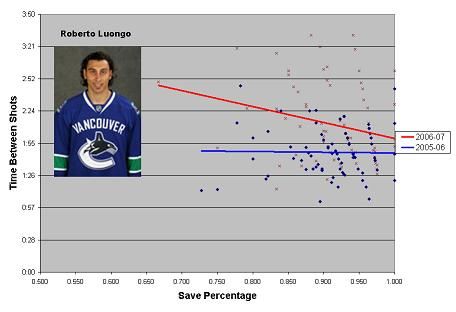 Robert Luongo: In 2005-6, workload appeared to have no discernable impact on Luongo's performance, but last year, after being traded from Florida to Vancouver, look at the downward slope of that red trendline; as the Time Between Shots dropped, Luongo's Save Percentage rose, and based on anecdotal observations this year (including a 47-save effort against Detroit earlier this month), it would appear that trend is continuing.
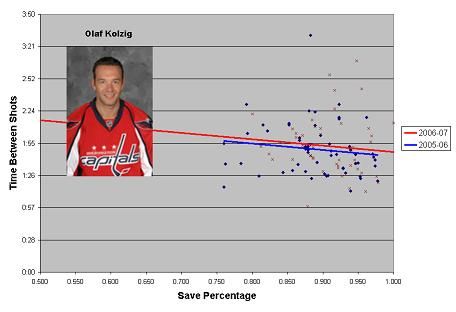 Olaf Kolzig: Godzilla's still battling away in Washington, and the consistency in his 2005-6 vs. 2006-7 numbers is striking; when facing shots more frequently, Kolzig tends to turn in a better performance. Can he put the young Caps on his back and lead them back to the playoffs for the first time since 2003? That's the big question...
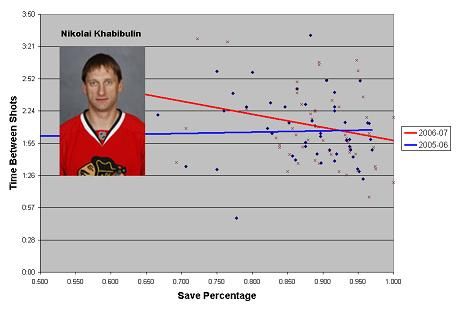 Nikolai Khabibulin: Much like Luongo, the Bulin Wall showed little impact from frequency of shots in 2005-6, but last year showed one of the strongest trends among this group in terms of ability to handle a barrage of shots against.
 Dwayne Roloson: Apparently a perfect match for an Edmonton team that gives up 31 shots a game, this 38 year-old still benefits from seeing more action.
SLOW IT DOWN, ALREADY!
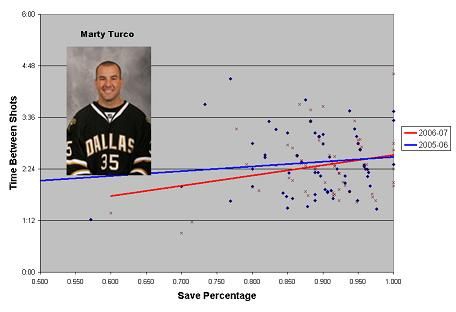 Marty Turco: As opposed to the four cases above, this veteran Dallas keeper had a slightly negative reaction to increased shots against in 2005-6, but that trend became more prevalent last year. Since the Stars boast one of the league's stingiest defenses in terms of giving up shots, it would appear that Turco makes a good fit there. For Turco, the more time he has between shots against, the better he performs.
I went back through the game-by-game details for #1 goaltenders over the last two full seasons, to find out which guys fare better facing a ton of shots, and which ones wilt under the pressure. The measurements presented in the graphs below represent Save Percentage for each game, measured against the average Time Between Shots that the goalie faced, with a trendline in bold summarizing that relationship across an entire season. A line that slopes downward to the right shows that as the Time Between Shots becomes shorter, the Save Percentage tends to increase. An upward sloping line indicates a Save Percentage that gets better when more time passes between shots.
For screening purposes, I'm looking at goalies who played at least 41 games in both the 2005-6 and 2006-7 seasons. What we end up with are the following candidates: Roberto Luongo, Miikka Kiprusoff, Martin Brodeur, Marty Turco, Rick DiPietro, Tomas Vokoun, Curtis Joseph, J.S. Giguere, Olaf Kolzig, Manny Fernandez, Henrik Lundqvist, Manny Legace, Nikolai Khabibulin, Marc-Andre Fleury, Ed Belfour, Marc Denis, Ryan Miller, Antero Niittymaki, Evgeni Nabokov, Dominik Hasek, and Dwayne Roloson.
Now remember, this covers 2005-6 and 2006-7, so I'm going to eliminate a few more names from this list because due to trade, injury or age, this year they are clearly no longer considered #1 goalies: Curtis Joseph, Manny Fernandez, Ed Belfour, Antero Niittymaki, Marc Denis, and Marc-Andre Fleury. This leaves us with 15 netminders to consider. There are certainly players who have ascended to the role of #1 (Chris Mason, Nicklas Backstrom, etc.) but I don't have the two full seasons worth of history to go through there, so I'm leaving them out as well. I'm also not digging into 2007-8 data, as the NHL changed their Game Summary format mid-stream, so further work is needed to derive that information.
The first interesting result is that for most goaltenders, there wasn't much of a link between frequency of shots and save percentage. Among the goaltenders that failed to show any strong trend in either direction were Miikka Kiprusoff, Martin Brodeur, Rick DiPietro, Tomas Vokoun, J.S. Giguere, Henrik Lundqvist, Manny Legace, Ryan Miller, Evgeni Nabokov, and Dominik Hasek. Also, when I looked at the combined work of all goaltenders across the league, there was no relationship found. Among the #1's, however, there were a few noteworthy expections...
THANK YOU SIR, MAY I HAVE ANOTHER?

SLOW IT DOWN, ALREADY!
