
Canucks vs. Stars, Round One Preview

The skinny on East vs. West in the NHL this year is that the Western Conference has had more defensive-oriented teams, and a perfect example of that trend is found in the Vancouver/Dallas series. Both teams have various strengths and weaknesses, but above all else they have been solid defensive performers all season, whereas few teams in the East can make the same claim.

So how do these teams match up? Let's take a look inside the numbers...


For table explanation, scroll down to the bottom of this post.

How Vancouver can score: The Canucks don't exactly light things up offensively, and perhaps their best chance at increased offense lies in long-distance shooting. The Dallas goaltending is quite poor on shots outside of 30 feet (note the Sht % Factor well above 1.00 in each case), and when you combine that with relatively good shooting from 40-49 and 50-59 feet for the Canucks, point shots on the power play coupled with effective screening could result in about one goal per game from long range, which is about three times what teams would normally average.
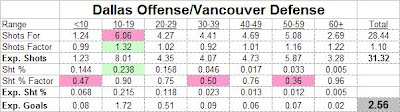


How Dallas can score: The Stars don't set the world on fire offensively either, and the prospect of facing Luongo can hardly give Dallas fans great hope. Notice how the "Sht % Factor" line is constantly below 1.00? That means there are no soft spots in Luongo's armor as seen in this view, and only one particular range wherein Dallas tends to score consistently well (10-19 feet). Overall, the Vancouver defense is giving up about 10% more shots than average, so the Stars may need quantity to make up for quality.

Summary: The Expected Goals values of 2.96 for Vancouver and 2.56 for Dallas would seem to indicate a moderate edge for the Canucks, although there are several other series with wider margins than this. Using Jeff Sagarin's guideline of giving the home team an extra 0.25 goals per game, Vancouver's advantage grows slightly more.

Outside the Numbers: This is the rare case where we have uncertainty in both teams' goaltending. For Vancouver, Luongo is making his playoff debut, so you never know how he's going to react. In Dallas, Marty Turco is trying to shake off the burden of previous postseason disappointments. I wouldn't neccesarily see any reason to adjust the results here in favor of one team over the other.

The Prediction: I'll take Vancouver in 7 games, with plenty of closely-fought 2-1 and 3-2 games keeping the fans on the edge the entire way.
-----------
Table Key:
Shots For = average of shots per game by that team, from the range specified.
Shots Factor = a factor representing how many shots the opposing defense yields in that range (1.24 = 24% more than average, 0.89 = 11% less than average).
Exp. Shots = "Shots For" times "Shots Factor", how many shots are expected to occur within each range.
Sht % = The fraction of shots from within that range result in goals.
Sht % Factor = a measure reflecting how the opposing goaltender handles shots from a given range (0.74 = 26% fewer goals than average, 1.53 = 53% more than average)
Exp. Sht % = "Sht %" times "Sht % Factor", the expected shooting percentage for this matchup.
Exp. Goals = "Exp. Shots" times "Exp. Sht %", the number of goals per game expected from each range.
Values indicative of significantly higher goal-scoring are shaded green, values for lower goal-scoring shaded pink.
All figures represent exponential moving averages, giving greater weight to recent performance. Empty-net goals and Penalty Shots are excluded.

Technorati Tags: stanley cup playoffs, vancouver canucks, dallas stars

Popular posts from this blog

Celebrating a milestone month

I've been remiss in providing regular updates on my quest to turn this whole sports-blogging hobby into at least something of a significant side income, if not a career, but good news has a way of prompting action. That, and I've been heads-down busy working on a few different fronts to push things forward...

Social Media, Internet Marketing, and Real, Paying Customers - it really works!

Applying the basic tenets of internet marketing (SEO best practices and social media network building) have helped me grow the readership and engagement over at On The Forecheck tremendously in recent years, but lately I've been wondering if those same techniques could be applied to small- or medium-sized local businesses, to help them drive real, tangible business results. I'm talking about not just drawing idle hockey fans looking to a blog so they can muse over line combinations, but helping businesses connect with potential customers in ways that otherwise wouldn't occur. Recently, I was able to help make just such a thing happen, and it shows just how great the opportunities are for small, local businesses which may not have the resources or skills available to extend their brand effectively on the internet.

NHL Fake Trades, an idea worth pursuing further in 2013

As I wrote about a month ago , I decided to jump upon a short-term opportunity and set up a "hot topic" website for the 2012 NHL Trade Deadline. NHLFakeTrades.com was inspired by a column by Eric Duhatschek of the Globe & Mail, who looked at the frenzy with which hockey fans jump on even the sketchiest of information about potential hockey trades, and wondered if some cash could be made by simply and forthrightly writing about fictitious trade scenarios. This meshed nicely with an exercise I went through a few years ago to create a Random Trade Generator, so in the course of a few hours I went ahead and registered the domain, set up a WordPress site using ( as I do at Hockey Gear HQ ) the wonderful Genesis framework with the News theme , and freshened up the Trade Generator for 2012. So how did it do, in terms of traffic, revenue, and accuracy of the trade projections? Let's take a look...